
When installing a stainless steel cable railing system, selecting the correct cable termination fittings is an important part of achieving a secure, professional installation.
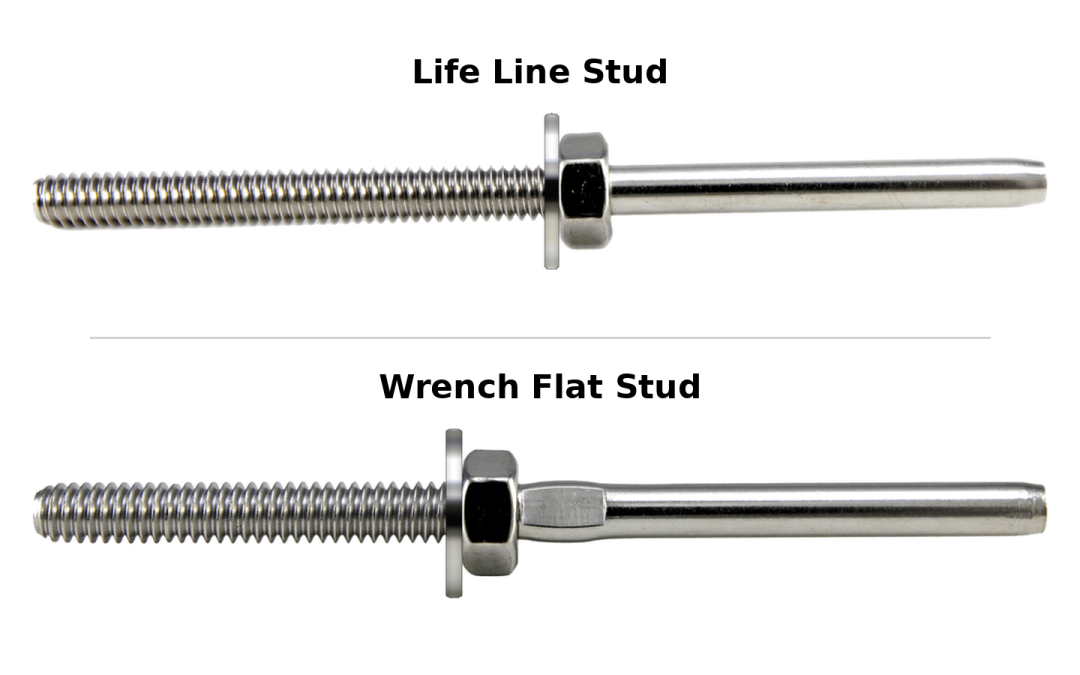
Two commonly used fittings are the Life Line Stud and the Wrench Flat Stud. Although both serve a similar purpose—connecting stainless steel cable to a threaded termination assembly—their designs offer different advantages during installation and tensioning.
At DeckRailing.net, we offer Madden Industries T316 marine-grade stainless steel cable railing fittings for residential decks, commercial railing systems, balconies, and architectural applications.
What Is a Life Line Stud?
A Life Line Stud is a stainless steel cable termination fitting featuring a threaded shaft and a swageable end designed to attach to stainless steel cable.
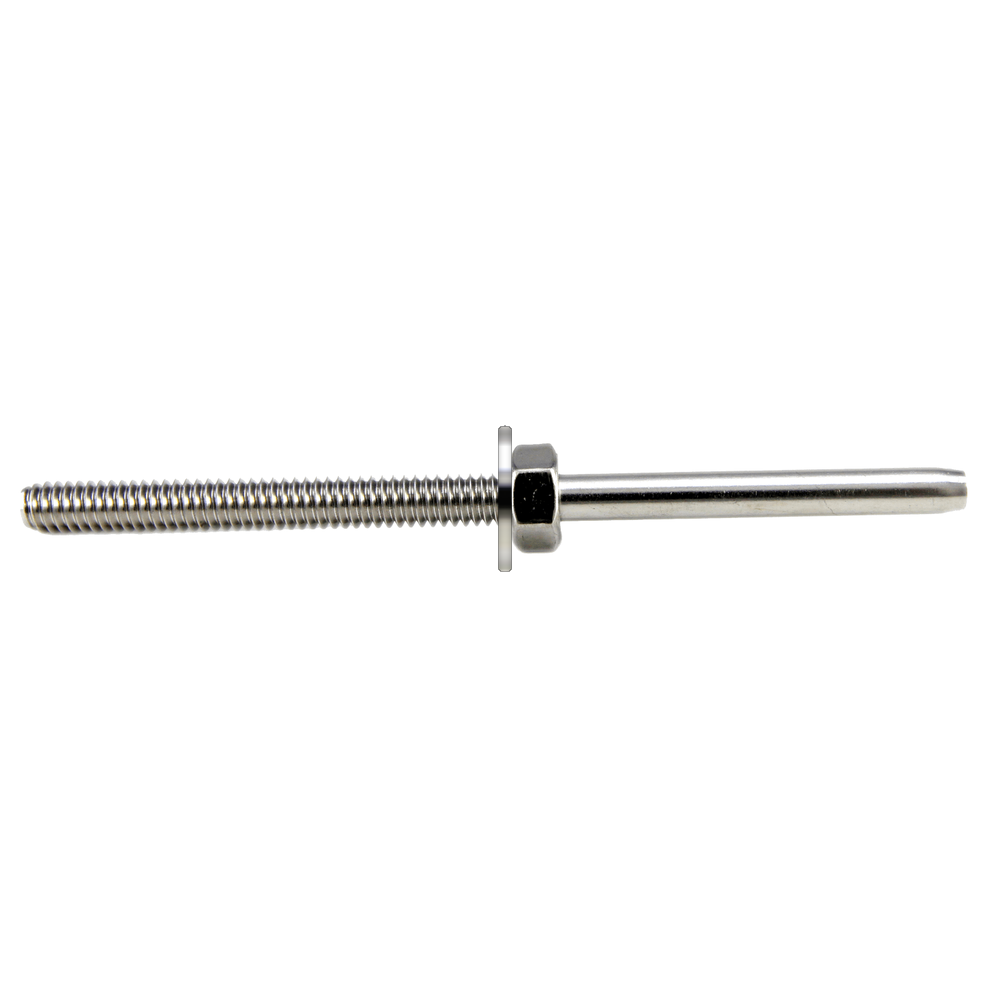
The threaded portion connects to compatible nuts, washers, or turnbuckle assemblies, allowing the cable to be secured and tensioned.
Advantages of Life Line Studs
- Threaded design accommodates compatible cable termination hardware.
- Available in configurations for different cable diameters.
- Compatible with selected turnbuckle assemblies.
- Provides cable adjustment through the appropriate threaded hardware.
- Available in hand-swage and machine-swage configurations.
- Manufactured from corrosion-resistant T316 stainless steel.
Common Applications
Life Line Studs are frequently used in residential and commercial cable railing installations where the design incorporates a threaded termination or turnbuckle assembly.
They can be used with compatible drop-pin, jaw, lag, and other turnbuckle arrangements, depending on the specific fitting and hardware.
Madden Industries offers Life Line Stud configurations for 1/8-inch and 3/16-inch stainless steel cable.
Shop Product: Life Line Stud with Flat Washer and Hex Nut – Hand and Machine Swage
What Is a Wrench Flat Stud?
A Wrench Flat Stud is another type of threaded stainless steel cable termination fitting.
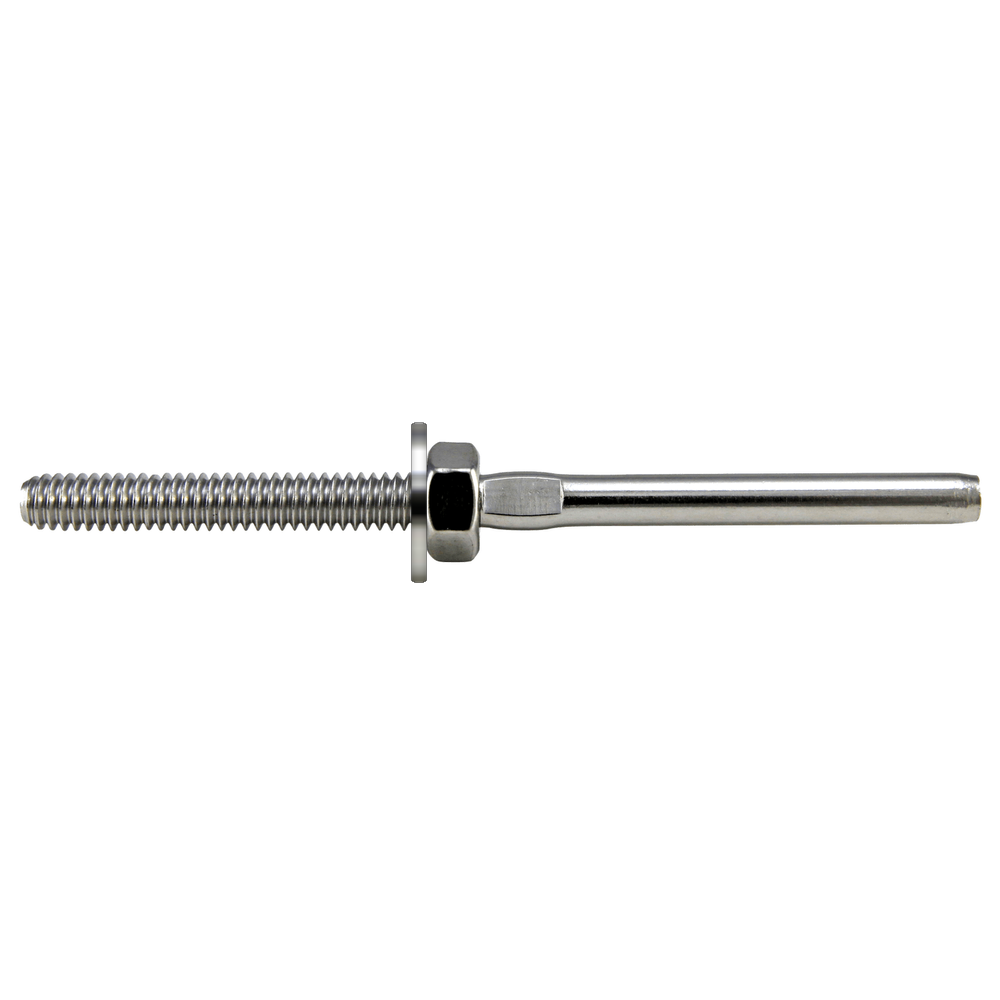
Its distinguishing feature is a machined section containing flat surfaces designed to accommodate a wrench.
These flats allow the installer to hold the fitting securely while tightening the retaining nut or adjusting the cable tension.
Advantages of Wrench Flat Studs
- Machined flats provide a positive wrench engagement point.
- Helps prevent unwanted fitting rotation during adjustment.
- Allows installers to hold the stud while tightening compatible hardware.
- Available in multiple lengths for different termination configurations.
- Suitable for compatible wood and metal post applications.
- Available in hand-swage and machine-swage configurations.
- Manufactured from corrosion-resistant T316 stainless steel.
Common Applications
Wrench Flat Studs are commonly used in residential deck railing, balconies, commercial railing systems, and architectural cable installations.
Madden Industries offers Wrench Flat Studs in various lengths, including 3.75-inch, 7.5-inch, and 10-inch configurations, depending on the product.
The appropriate stud length should be selected based on the post dimensions, termination hardware, and available adjustment.
Shop Product: Wrench Flat Stud with Flat Washer and Hex Nut – Hand and Machine Swage
Life Line Stud vs. Wrench Flat Stud: Key Differences
The primary differences are summarized below.
| Feature | Life Line Stud | Wrench Flat Stud |
|---|---|---|
| Primary design | Threaded cable termination | Threaded termination with machined wrench flats |
| Wrench engagement | Depends on termination hardware | Built-in wrench engagement surfaces |
| Cable tensioning | Compatible nuts or turnbuckle assemblies | Compatible nuts or turnbuckle assemblies |
| Installation advantage | Versatile threaded connections | Easier to hold during adjustment |
| Swage compatibility | Hand or machine, depending on model | Hand or machine, depending on model |
| Available lengths | Varies by fitting configuration | Multiple lengths available |
| Material | T316 stainless steel | T316 stainless steel |
| Primary consideration | Threaded connection compatibility | Wrench access and adjustment control |
Important: Neither fitting is inherently stronger or better for every application. The correct choice depends on the specific fitting specifications, termination hardware, cable diameter, post configuration, and installation requirements.
Which Cable Railing Stud Should You Choose?
Choosing between a Life Line Stud and a Wrench Flat Stud depends on how your cable railing system is designed and how the cables will be secured and tensioned.
Residential Deck Railing
For residential deck railing installations, both fitting styles can provide suitable termination options when properly matched to the railing system.
Commercial Cable Railing
Commercial cable railing installations often involve numerous cable runs, repetitive terminations, and specific structural requirements.
Both Life Line and Wrench Flat Studs can be appropriate, provided the complete cable railing assembly meets the applicable engineering and installation requirements.
Wood and Metal Posts
Both stud styles can be used in appropriately designed wood or metal post assemblies.
However, several factors must be considered:
- Post material and structural capacity
- Post thickness and termination hole dimensions
- Washer bearing area
- Available thread engagement
- Access for installation and adjustment
- Required cable tension
A fitting suitable for one post configuration may require a different length or attachment arrangement in another.
Stair and Angled Cable Railing
Stair railing installations require special consideration because the cable approaches the termination post at an angle.
In these applications, a straight threaded stud may not provide the proper alignment.
An angled terminal, pivoting fitting, or compatible toggle assembly may be required to allow the cable to follow the stair slope without creating an improper bend at the termination.
Always select fittings appropriate for the cable angle and railing design.
Understanding Cable Railing Tensioning
Cable railing systems use tensioned stainless steel cables to maintain consistent spacing and help limit cable deflection between supports.
During installation, cables should be tensioned gradually and consistently according to the railing system manufacturer’s instructions.
Excessive tension can place unnecessary loads on termination posts, mounting hardware, and structural connections.
A properly designed cable railing system must account for cable tension, post strength, support spacing, and the applicable building code requirements.
Hand Swage vs. Machine Swage Compatibility
Both Life Line Studs and Wrench Flat Studs are offered in configurations designed for different cable attachment methods.
Hand swaging uses compatible manual or portable compression equipment to attach a specially designed fitting to stainless steel cable.
Machine swaging uses specialized mechanical or hydraulic equipment to compress a compatible fitting around the cable.
While both methods can produce reliable connections when performed correctly, the fittings and tooling are not necessarily interchangeable.
Before installing a swage fitting, always verify:
- Cable diameter and construction
- Fitting compatibility
- Required swaging method
- Correct tooling and compression procedure
- Manufacturer installation requirements
The fitting must be designed for the intended swage method.
A hand-swage fitting should not be substituted for a machine-swage fitting unless the manufacturer specifically approves the combination.
For a more detailed explanation, see our upcoming guide: Hand Swage vs. Machine Swage Cable Railing Fittings: Which Is Better?
Why T316 Stainless Steel Matters
Madden Industries Life Line and Wrench Flat Studs are offered in T316 stainless steel.
T316 stainless steel contains molybdenum, which improves resistance to certain types of corrosion, particularly in environments exposed to moisture and chlorides.
However, stainless steel is corrosion-resistant rather than corrosion-proof.
Proper installation, material compatibility, cleaning, and maintenance remain important, especially in coastal or chemically aggressive environments.
Common Cable Railing Installation Mistakes to Avoid
1. Selecting the Wrong Cable Diameter
Always confirm that the stud is compatible with the stainless steel cable being installed. A fitting intended for 1/8-inch cable should not be used with 3/16-inch cable unless specifically designed for both.
2. Using Incorrect Swaging Equipment
Hand-swage and machine-swage fittings may require different tools and compression procedures. Using the wrong equipment can compromise the connection.
3. Insufficient Thread Engagement
Verify that the threaded portion provides adequate engagement with the selected termination hardware.
4. Allowing the Cable to Twist During Tensioning
Unwanted rotation can introduce twist into the cable assembly. Wrench Flat Studs provide a convenient means of holding the fitting during adjustment.
5. Overtensioning the Cable
Excessive tension can overload posts and mounting connections. Follow the system manufacturer’s tensioning recommendations.
6. Ignoring Post Spacing and Cable Support
Cable railing performance depends on more than the termination fittings. Post spacing, intermediate supports, cable spacing, and structural connections must work together as a complete system.
Frequently Asked Questions
What is the main difference between a Life Line Stud and a Wrench Flat Stud?
The primary difference is the fitting design. A Wrench Flat Stud incorporates machined surfaces that allow an installer to hold the fitting with a wrench during adjustment. A Life Line Stud is a threaded cable termination commonly used with compatible nuts, washers, and turnbuckle assemblies.
Is a Wrench Flat Stud stronger than a Life Line Stud?
Not necessarily. Connection strength depends on the specific fitting design, material, cable compatibility, swage quality, and manufacturer specifications. Wrench flats alone do not indicate a higher load rating.
Can both fittings be used with stainless steel cable railing?
Yes. Both styles are available for compatible stainless steel cable railing applications. Always select the correct cable diameter, fitting configuration, and swaging method.
Can Life Line Studs and Wrench Flat Studs be used with turnbuckles?
Yes, when the thread specifications, dimensions, and fitting design are compatible with the selected turnbuckle assembly. Not all threaded studs and turnbuckles are interchangeable.
Which stud is easier to install?
Wrench Flat Studs can make certain adjustments easier because the machined flats provide a place to hold the fitting with a wrench. However, overall installation difficulty depends on the termination design, post configuration, and available access.
Can these fittings be used with wood posts?
Yes, selected configurations can be used with appropriately designed wood post assemblies. The post must provide sufficient structural capacity and accommodate the selected termination hardware.
Shop Cable Railing Studs at DeckRailing.net
At DeckRailing.net, we offer Madden Industries T316 marine-grade stainless steel cable railing fittings for residential and commercial applications.
Explore Our Cable Railing Products:
- Life Line Stud with Flat Washer and Hex Nut – Hand and Machine Swage
- Wrench Flat Stud with Flat Washer and Hex Nut – Hand and Machine Swage
- Shop All Stainless Steel Threaded Terminals and Studs
Need help choosing the right cable railing fittings?
Contact the DeckRailing.net team for assistance selecting compatible cable railing components for your project.
DeckRailing.net — Quality Cable Railing Components by Madden Industries.
Recent Comments